
What is Organisation all about?
- Structuring research excellence through specialised departments.
- Combining knowledge across disciplines in multidisciplinary teams.
- Connecting science, industry and society for real-world impact.
- Fostering collaboration from the laboratory to society.
IREC’s organisation is designed to support excellence in applied energy research and innovation. Structured into specialised departments and multidisciplinary teams, the institute fosters collaboration across scientific, technological and transfer activities. This integrated model enables IREC to address complex energy challenges, connect research with real world applications, and maximise its impact on industry, policy and society.
Structured departments driving research excellence
IREC is organised into specialised departments that focus on key areas of energy research and innovation, enabling depth of expertise while ensuring alignment with the institute’s overall strategic goals.
From research to real-world application
The organisational model connects research, technology development and transfer, ensuring that scientific results evolve into practical solutions with impact on industry and society
Multidisciplinary collaboration across teams
Teams work in a highly collaborative and interdisciplinary environment, combining knowledge from different fields to address complex energy challenges and develop integrated solutions.
Aligned with strategic projects and societal needs
Departments are closely linked to IREC’s strategic initiatives and projects, contributing to the energy transition by addressing real societal, industrial and environmental needs.
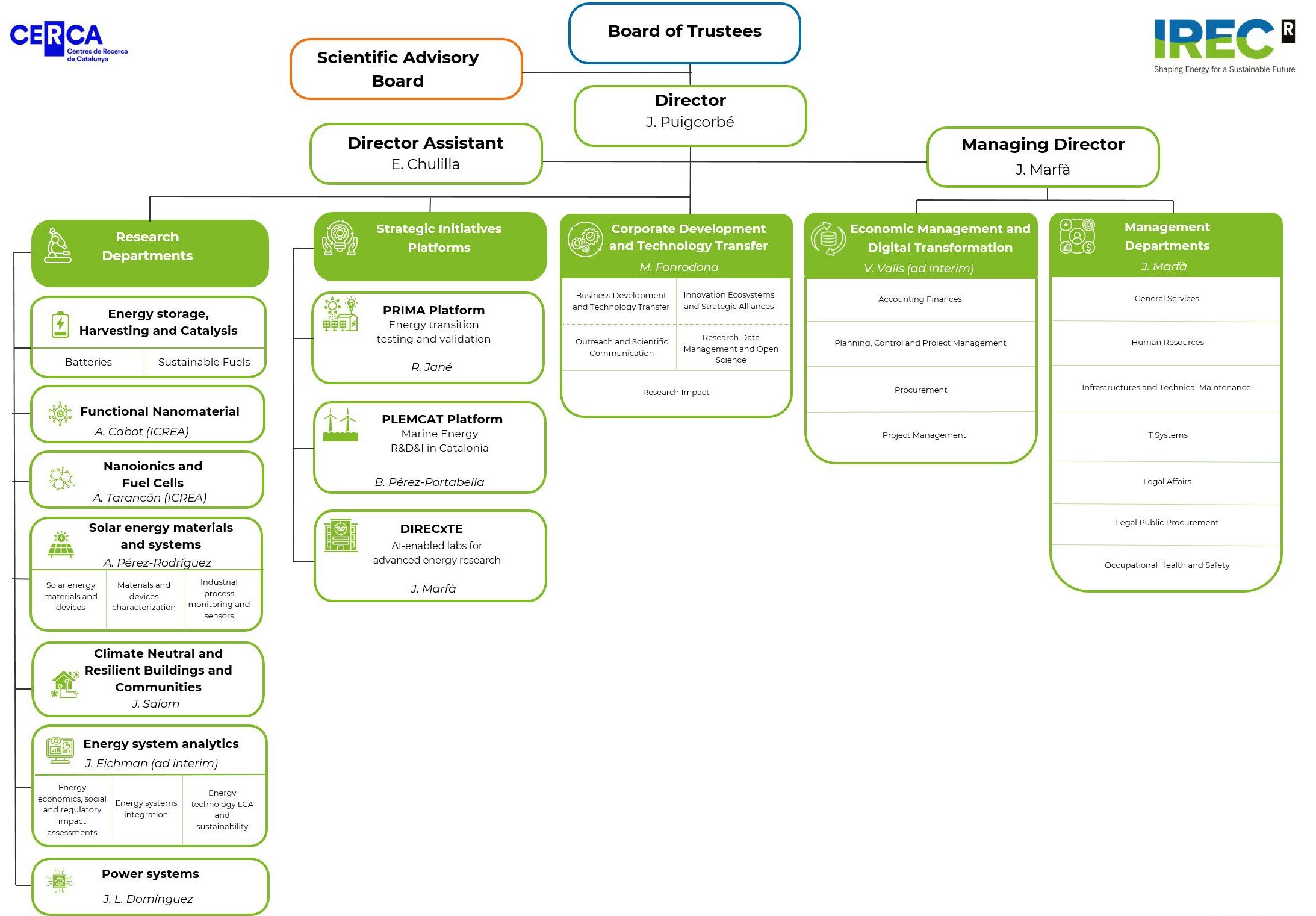
Organisational chart
IREC’s organisational chart outlines its governance structure and internal organisation, bringing together leadership, research departments and support areas. This model enables coordinated decision-making, multidisciplinary collaboration and the effective delivery of research and innovation activities.
Boards
IREC’s governance is structured through dedicated boards that provide strategic direction, expert guidance and oversight in support of the institute’s mission and long term impact.

Board of trustees
IREC is a public research institute governed by a public-private Board of Trustees, which includes the Generalitat de Catalunya, the Spanish Government, three Catalan universities, and representatives from the energy industry.

Scientific Advisory Board
The scientific advisory board brings together leading experts from academia, industry and the public sector to provide independent guidance and support IREC’s strategic development and long term positioning.
Our management departments
IREC’s management departments support the institute’s operations and ensure effective coordination across key functions, enabling research and innovation activities.

Planning, control & project management
This department ensures the effective planning, monitoring and execution of IREC’s projects and activities. It oversees resource allocation, timelines and performance indicators, supporting informed decision-making and alignment with strategic objectives.

Accounting finances
The accounting and finance department manages IREC’s financial resources, ensuring transparency, compliance and sustainability. It oversees budgeting, financial planning, reporting and auditing processes, supporting the institute’s operations and strategic growth. By providing accurate financial insights and control, it enables efficient resource management and supports decision making across all areas of the organisation.

Project Management
The project management department supports the coordination and implementation of research and innovation projects across IREC. It ensures alignment between teams, stakeholders and objectives, facilitating communication, risk management and administrative processes. By streamlining project workflows and supporting funding requirements, it contributes to the successful delivery and impact of national and international initiatives.

Corporate comunication
The corporate communication department defines and implements IREC’s communication strategy, ensuring consistent messaging across all channels. It promotes research, projects and achievements, strengthening visibility and reputation among stakeholders. By engaging with media, partners and society, it supports knowledge dissemination and positions IREC as a key voice in the energy transition and its impact on industry and communities.

Procurement
The procurement department manages the acquisition of goods and services required for IREC’s operations and projects. It ensures compliance with public procurement regulations, transparency and efficiency in all processes. By coordinating with internal teams and external suppliers, it guarantees the timely delivery of resources, optimises costs and maintain quality standards, supporting the effective execution of research and innovation activities.

Legal Affairs
The legal affairs department provides legal support across all areas of IREC, ensuring compliance with applicable regulations and institutional policies. It advises on contracts, agreements and governance matters, mitigating risks and supporting decision-making processes. By safeguarding legal integrity, it contributes to the secure, transparent and responsible development of research, innovation and collaboration activities.

Legal Public
The legal public department ensures compliance with public sector regulations and administrative procedures applicable to IREC. It overseeslegal frameworks related to governance, transparency and institutional obligations, supporting contracts, agreements and regulatory processes. By ensuring alignment with applicable laws and public standards, it reinforces accountability, integrity and trust across all institutional and research activities.

Human resources
The human resources department manages talent attraction, development and retention across IREC. It supports recruitment, training, performance management and employee wellbeing, fostering a collaborative and inclusive work environment. By aligning people strategies with organisational goals, it enables teams to perform effectively promotes professional growth and contributes to building a strong, engaged and motivated workforce.

Occupational Health & Safety
The occupational health and safety department ensures a safe and healthy working environment for all IREC staff. It defines and implements prevention policies, risk assessments and safety protocols across facilities and activities. By promoting a culture of safety and wellbeing, it minimises risks, ensures compliance with regulations and supports the continuous improvement of working conditions.
Infrastructures & Technical Maintenance
The infrastructures and technical maintenance department ensures the proper operation, maintenance and optimisation of IREC’s facilities and technical systems. It manages infrastructure performance, equipment reliability and preventive maintenance, supporting research activities in safe and efficient conditions. By coordinating technical resources and services, it guarantees operational continuity and contributes to the quality and sustainability of the institute’s working environments.
General Services
The general services department supports the day to day operations of IREC by managing logistics, facilities and internal services. It coordinates resources, spaces and operational needs to ensure a smooth and efficient working environment. By providing essential support across departments, it contributes to organisational efficiency, enhances workplace conditions and enables research and administrative activities to run effectively.

IT Systems
The it systems department manages and maintains IREC’s digital infrastructure, ensuring secure, reliable and efficient technological services. It supports data management, connectivity, cybersecurity and digital tools used across the organisation. By enabling innovation through technology, it facilitates collaboration, protects information assets and ensures that research and operational activities are supported by robust and scalable systems.