
IREC assesses the impact of floods on Barcelona’s electricity infrastructure
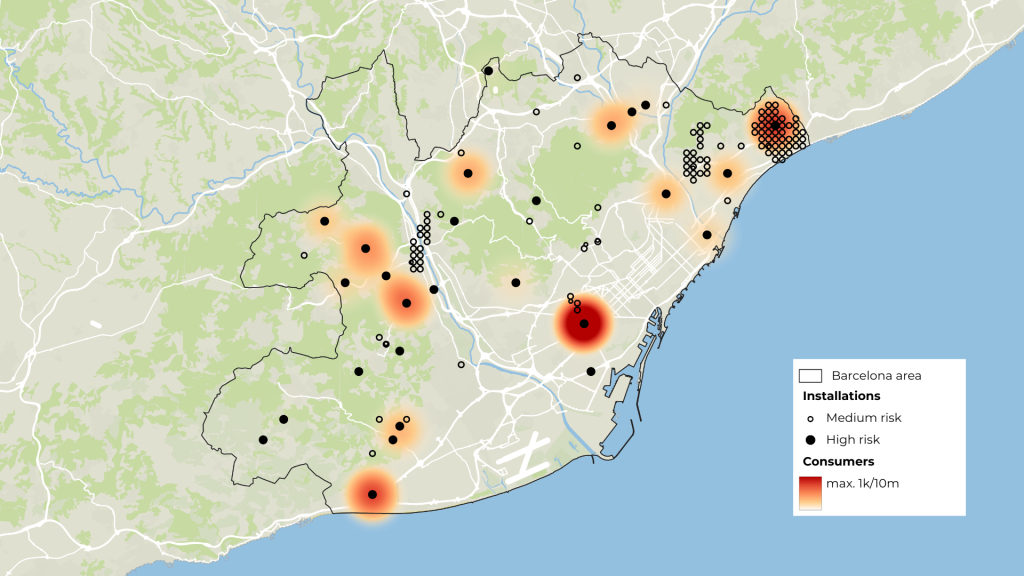
IREC has developed a planning tool that allows to locate and quantify the risks that flooding can pose to the electricity grid in the Barcelona metropolitan region. The aim is to help public authorities make early decisions on climate adaptation based on scientific data.
Over the past three years, the European project ICARIA, led by Veolia and the Universitat Politècnica de Catalunya (UPC), has analysed how climate change can intensify the effects of flooding caused by both extreme rainfall and maritime storms and wave action. These types of episodes, known as compound events, occur when several phenomena coincide within the same period, amplifying their impacts. According to these studies, areas vulnerable to serious rainfall-induced flooding in the Barcelona metropolitan region could increase by up to 25% over the next 75 years.
In this context, the project has developed urban flood models that have been used to produce flood risk maps for all municipalities in the metropolitan area. These maps classify risk according to different severity levels and various future climate change scenarios.
Given the growing impact of these phenomena on critical infrastructure, IREC has applied its own risk analysis methodology to the electricity grid, which also allows for the study of possible adaptation measures in the event of flooding. This methodology identifies both direct impacts — such as those that substations and electricity distribution centres may suffer, and indirect impacts on consumers, who ultimately experience the consequences.
As explained by Pol Paradell, researcher in IREC’s Power Systems department: “This methodology was initiated within the framework of the RESCCUE project, with applications in Barcelona and Bristol“, and he adds, “now, in the ICARIA project, we have expanded and optimised this scope so it can be applied to larger areas, such as the Barcelona metropolitan area, thus facilitating decision-making by public bodies based on scientific data“.
The analysis has also enabled historical projections and an economic estimation of the impacts of flooding on the electricity grid. According to the results, an extreme event such as a DANA or a storm like Gloria could cause around 5 million euros in damage every 10 years. Overall, the expected annual damage is estimated between 3 and 4 million euros in the Barcelona metropolitan region alone, of which approximately half corresponds to direct damage to infrastructure and the other half to impacts on grid users and cascading effects on other infrastructures.
A tool usable in other European cities
In addition to the Barcelona case, the project has also carried out studies in the European regions of Salzburg (Austria) and the South Aegean Islands (Greece) to quantify the impact of extreme climate events — such as heatwaves, flooding, maritime storms, extreme winds or wildfires — on housing and critical infrastructure, including roads and the electricity grid. The three case studies (including Barcelona) therefore present different scenarios that can be extrapolated to other European regions.
The adaptation measures proposed in the ICARIA project are designed to be replicable across Europe, enabling other areas to incorporate them into their climate adaptation policies. Today, we launch a press release in 3 languages:
About ICARIA
The ICARIA project, led by Veolia in Spain and Universitat Politècnica de Catalunya (UPC), has been carried out over more than three years in collaboration with 14 other European partners, including the Catalonia Institute for Energy Research (IREC), Cetaqua , Aigües de Barcelona or Àrea Metropolitana de Barcelona (AMB).
More information on the project website ICARIA.
Funded by the European Union (Grant Agreement No. 101093806). Views and opinions expressed are however those of the author(s) only and do not necessarily reflect those of the European Union or European Climate, Infrastructure and Environment Executive Agency (CINEA). Neither the European Union nor the granting authority can be held responsible for them.