
IREC advances next-generation battery technologies through the European HELIOS project
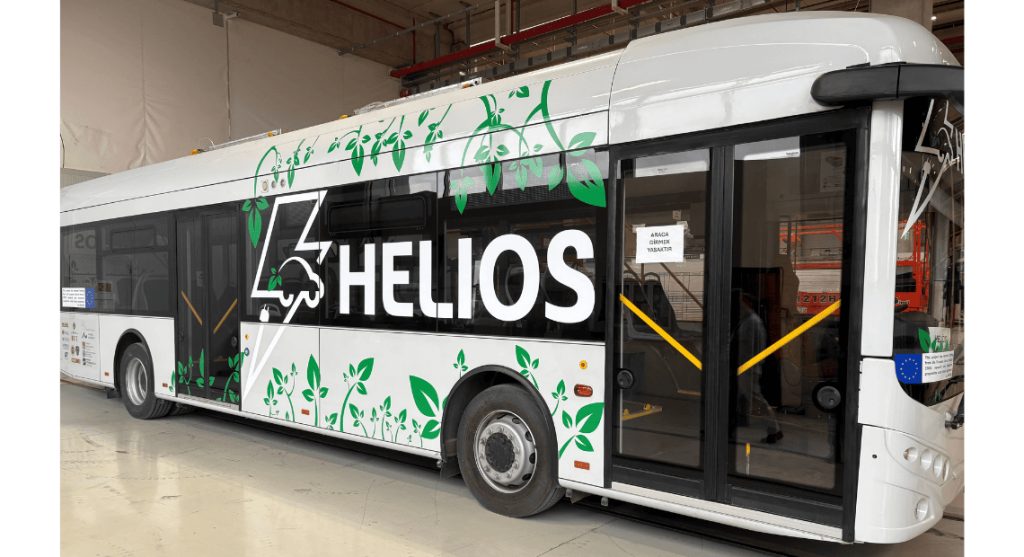
The European project HELIOS, funded under the Horizon 2020 programme, has concluded after 4 years of work with significant progress toward safer, more efficient and more sustainable battery systems for urban electric mobility. The initiative, coordinated by Aarhus University and involving 18 partners from across Europe, set out to create a new concept of smart, modular and scalable battery packs suitable for a wide variety of electric vehicles, from mid-size EVs to electric buses. The project’s ambition was to improve energy and power density, safety, fast-charging capability and lifetime, while reducing the overall cost and environmental impact of battery systems throughout their full life cycle.
Within the consortium, IREC played a key role through the contributions from the Power Systems (José Luis Domínguez, Àlber Filbà and Clàudia Cabré) and Energy Systems Analytics (Victor Ferreira, Tomás Montes and Anna Sanchez) departments. These teams worked on advanced power electronics, control and communication strategies, and led the life-cycle and cost analyses that guided the design towards sustainable and circular solutions. IREC contributed to the validation of second-life battery applications , helping ensure that the HELIOS technologies can be integrated into real-world mobility services. The life-cycle cost (LCC) assessment carried out by IREC identified the main cost drivers of prototype battery packs and demonstrated that industrial-scale manufacturing could reduce total pack costs by up to 60%, aligning with future market targets. This analysis also provided quantitative evidence that second-life applications can extend battery value while lowering the overall cost per kilowatt-hour delivered.
One of the notable technological achievements reached with IREC’s involvement is the development of a new modular power conversion architecture that enables improved performance and flexibility when integrating second-life batteries.
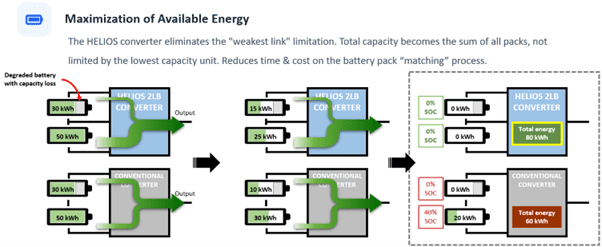
When connecting battery modules in series with conventional power converters, the current retrieved from each module is limited by the module with lowest remaining energy. Hence, once a module has fully discharged, the energy stored in the rest of the modules cannot be effectively used. The HELIOS multilevel converter overcomes this limitation by allowing independent current, and thus energy, control for each module. This capability also allows module state of charge balancing without energy losses or the need for additional circuitry.
In second-life battery applications, this feature is particularly valuable, as it allows the use of less accurate, and therefore faster and more cost-effective, state-of-health estimation methods. In other words, the proposed architecture not only tolerates but maximizes the differences in available energy of batteries with different states of health, efficiently integrating them under a single grid interface. The architecture developed in HELIOS is also easily scalable, enabling the integration of additional battery modules or clusters with minimal modification.
In a global approach to electric mobility applications, this power converter allows repurposing of EV batteries for their second life as support to fast-charging stations. This additional energy storage can provide peak shaving capabilities and thus help to avoid grid reinforcement and power demand curtailment while also delivering services that enhance grid stability.
To test the feasibility of this technology, IREC developed a scaled prototype (5 kW, TRL5-6) and tested it in a relevant scenario that emulated its final application, including a real EV and a fast-charging station to the testing loop.
With these results, HELIOS demonstrates the feasibility of combining high technical performance with sustainability and lifecycle-oriented design. IREC’s contributions have helped position the project as an important step forward in the development of advanced, modular battery systems capable of supporting Europe’s transition to cleaner and more resilient urban mobility models.
Acknowledgements: This project has received funding from the European Union’s H2020 research and innovation programme under grant agreement number 963646.