
Advancing Sustainable Aviation Fuels with tailored catalytic materials
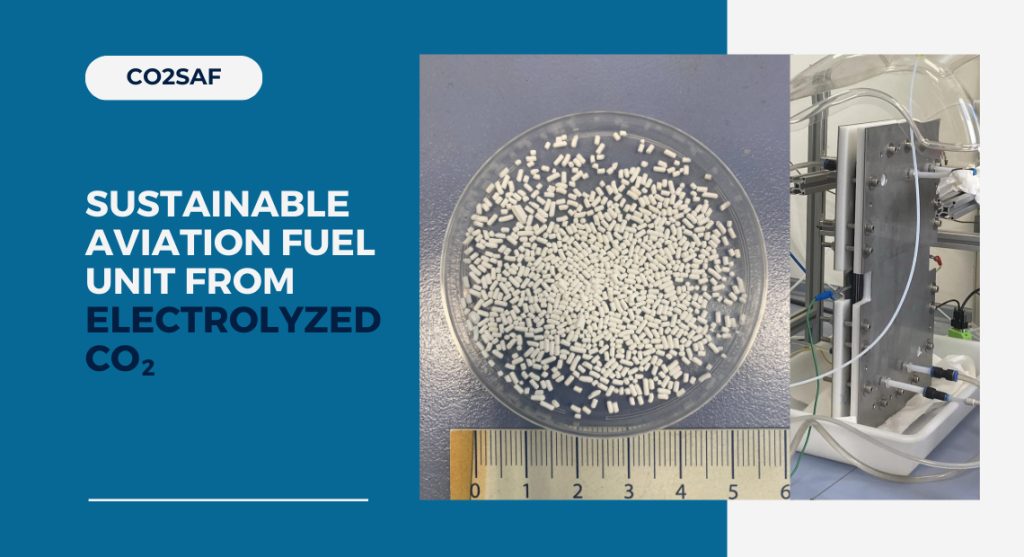
The CO2SAF project focused on developing a one-stage syngas-to-Sustainable Aviation Fuel (SAF) unit, integrating Fischer-Tropsch synthesis and hydrocracking catalytic processes. By utilizing electro-reduced CO2 as the carbon feedstock, the project aimed to produce low-carbon aviation fuels, addressing the challenges of decarbonizing the aviation sector. This approach provides a pathway for directly converting CO2-enriched syngas into kerosene-range hydrocarbons, aligning with the growing need for sustainable aviation solutions.
One of the key outcomes was the development of an optimized electro-catalytic process for the reduction of CO2 to CO. Advanced electrode materials and cell designs, informed by multi-physics computational simulations, achieved current densities of 150 mA/cm², Faradaic efficiencies exceeding 90%, and CO2 conversion rates over 40%. The process demonstrated stable operation for extended durations, representing an important step toward reliable electrochemical CO2 utilization technologies. The project also advanced the development of catalysts for hydrocracking, particularly through the shaping of zeolite-based materials, by combining zeolite with boehmite and using acetic acid as a peptizing agent. Additionally, the incorporation of PMMA as a pore-forming agent increased macroporosity, while mesoporosity played a critical role in enhancing the dispersion and availability of active sites. These features significantly improved the catalysts’ performance in hydrocracking reactions, demonstrating their potential for producing kerosene-range hydrocarbons.
The integration of advanced catalytic materials and processes enabled the production of SAF with a focus on the kerosene fraction (C9-C16). Fischer-Tropsch synthesis was successfully performed under high CO2 concentrations without the need for extensive gas conditioning. ALD-promoted ceria catalysts improved product selectivity, with over 40% of hydrocarbons in the kerosene range and a 10% increase in selectivity compared to conventional cobalt-based catalysts. This work highlights the role of tailored catalytic materials and zeolite-based supports in advancing sustainable aviation fuels, contributing to the broader decarbonization goals of the aviation sector.
Acknowledgements (in Spanish)
CO2SAF (TED2021-132365B-I00) es un proyecto financiado por MCIN/AEI/10.13039/ 501100011033 y por la Unión Europea “NextGenerationEU”/PRTR.
