
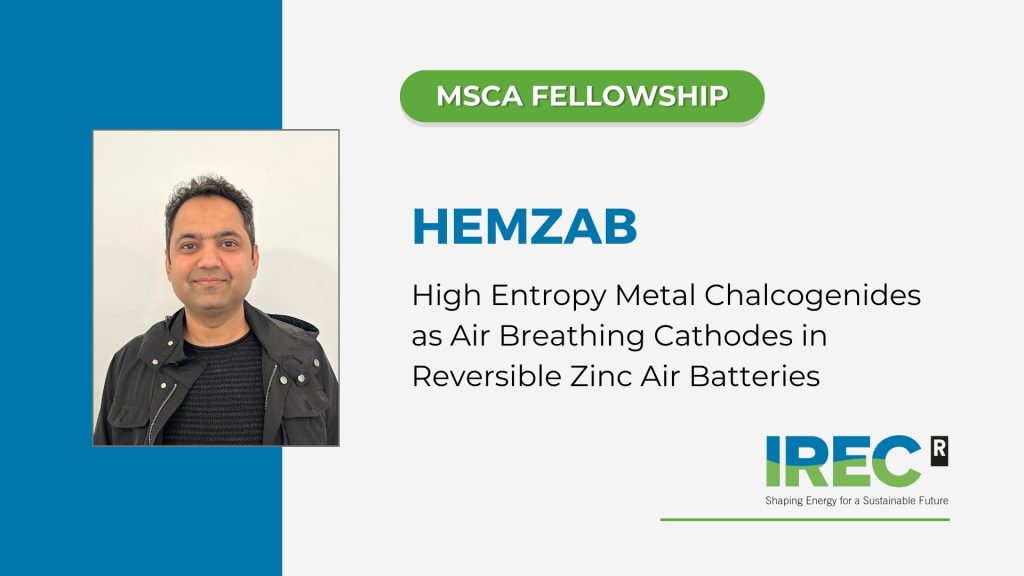
HEMZAB will develop oxygen catalysts for enhanced Zn-air batteries
Li-ion batteries are leading the energy storage market both in the electric vehicle and portable electronic fields. However, these batteries still suffer from moderate energy density, relatively high costs and potential safety issues.
Scientists are constantly seeking for alternatives that are cheaper, safer, and more widely available. A promising candidate to replace conventional batteries are Zn-air batteries that rely on the oxidation of zinc with oxygen in the air. These batteries have higher energy density, and are low cost, inherently safe and environmentally friendly. However, the widespread adoption of Zn-air batteries faces two major challenges: slow oxygen redox reactions and unstable cathode materials.
To address these issues, Malik Dilshad Khan is joining the Functional Nanomaterials Department at IREC under the supervision of Prof ICREA Andreu Cabot, in the framework of a Marie Curie Postdoctoral Fellowship (MSCA-PF) called HEMZAB. The fellowship has a total budget of ~165K€ and will run for 24 months, starting this December. Additionally, the fellowship includes a non-academic placement at the Institute of Science and Technology-Austria (ISTA), strengthening IREC’s link to this institution.
HEMZAB, which stands for “High Entropy Metal Chalcogenides as Air Breathing Cathodes in Reversible Zinc Air Batteries”, aims to develop high-entropy metal chalcogenides to be used as oxygen redox catalyst to overcome the low performance and stability issues of current air cathodes used in reversible Zn-Air batteries.
Link to CORDIS: https://cordis.europa.eu/project/id/101155152
Acknowledgements
Funded by the European Union (GA No. 101155152). Views and opinions expressed are however those of the author(s) only and do not necessarily reflect those of the European Union or the European Innovation Council and European Research Executive Agency (REA). Neither the European Union nor the granting authority can be held responsible for them.
