
Advancing 3D-printed all solid-state Li-ion batteries
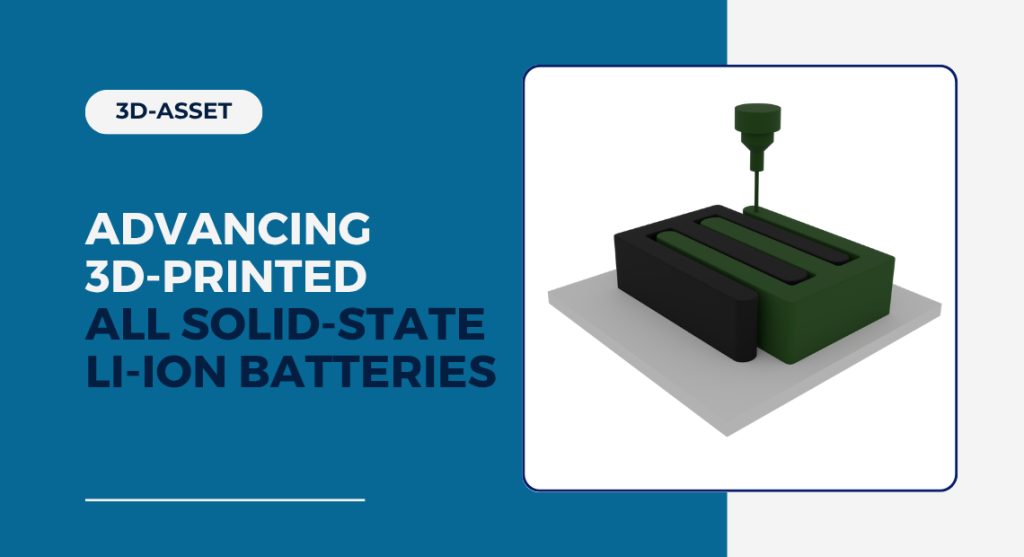
The 3D-ASSET project which aimed to develop a new generation of highly performing advanced all-solid-state Li-ion batteries (ASSBs) digitally manufactured-by-design, has ended. To achieve this, the shape and architecture of components and cells have been optimized based on novel materials and 3D printing manufacturing techniques.
The project focused on the development of advanced materials for ASSBs with high performance capabilities and their effective implementation in slurries, inks and filaments for different 3D printing technologies. Efforts were made to improve electrolyte-electrode interfaces by different coating strategies. The development of these feedstocks served to advance in the fabrication of a new generation of cobalt-free and anode-less (i.e. no lithium excess, as all lithium is contained in the cathode material) 3D printed monolithic batteries (including co-sintering).
After more than two years of research, 3D-ASSET has obtained several key advancements across multiple domains. The project achieved the 3D printing of LFP electrodes using Fused Filament Fabrication, offering high geometric flexibility for tailored designs and enhanced performance. Additionally, sintering of monolithic ceramic cathode-electrolyte structures at high temperatures was accomplished, delivering performance levels approaching practical theoretical limits. Improved interfaces between the ceramic electrolyte and the Li anode were also achieved, enabling greater interfacial stability and anodeless battery operation. Furthermore, advanced Transmission Electron Microscopy (TEM) techniques were developed, including operando methodologies and AI-driven routines for nanoscale characterization of materials and interfaces.
Two departments of IREC participated in the project contributing with their expertise in 3D printing of advanced ceramics and batteries. Alex Morata from the Nanoionics and Fuel Cells department, coordinator of the project, led the sub-project “Development of next generation all-solid-state lithium batteries by 3D printing combined fabrication techniques” (ALLIANCE), which developed ceramic solid-state batteries. Jordi Jacas from the Batteries group of the Energy Storage, Harvesting and Catalysis department led the sub-project “Stable olivine cathode materials with high specific energy for solid state batteries” (OLiBat), which developed a greener synthesis route and electrode fabrication process using hydrothermal methods to produce the initial ceramic material.
The consortium of 3D-ASSET is formed by IREC, CIC energiGUNE, Universidad de Castilla la Mancha (UCLM) and Universitat de Barcelona (UB).
Acknowledgements (in Spanish)
Los proyectos 3D-ASSET (TED2021-129663B-C51) y OLIBAT (TED2021-129663A-C53) están financiados por MCIN/AEI/10.13039/ 501100011033 y por la Unión Europea “NextGenerationEU”/PRTR.
