
Conclusions of the FUSIONCAT project, completed this year
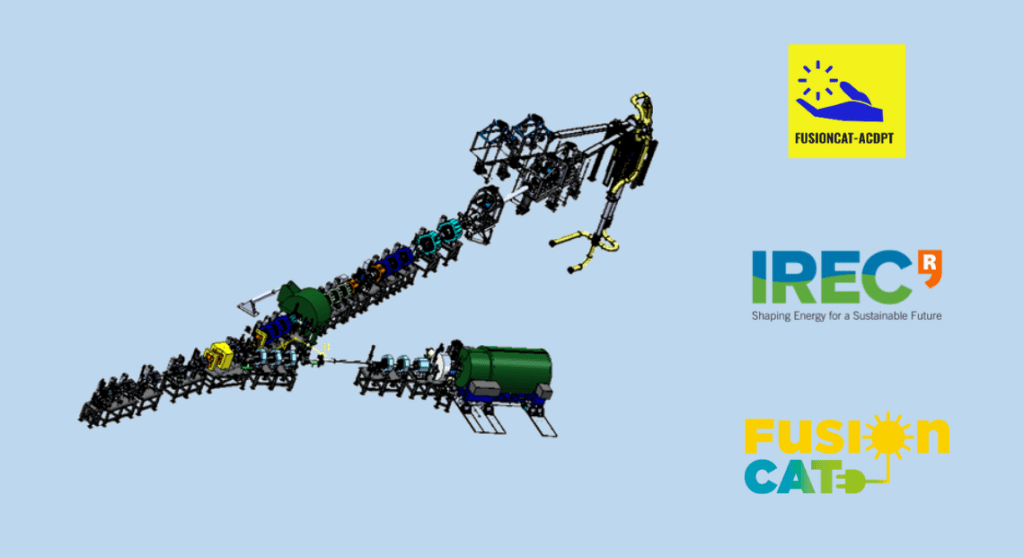
FUSIONCAT is a project initiative that gathers the active research groups on nuclear fusion energy in Catalonia and aims to establish technology transfer from the partner institutions to local industry.
Focused on the future IFMIF, which is a fusion materials research facility by a particle accelerator, bFUS team of IREC has managed the analysis and design of accelerator components in different tasks.
First task is lessons learnt from IFMIF-EVEDA, project developed in Japan, which the commissioning was finalised in 2019. The lessons learnt include different topics such as vacuum sensors, beam dump, connection systems among others. All these lessons have been compiled and documented in different reports.
The second task carried out was to develop a software tool to help future designers. The tool, called “Fusion Accelerator Components Development and Positioning Tool (ACDPT)”, covers different aspects from mechanical topics, such as drift tube thickness or bellow design, to simulation assistance tools.
This tool has been already used in IFMIF-DONES project in which bFUS team is currently working.
The last task done, together with EURECAT, has been reaching different local suppliers and manufacturers. The idea of this assignment is to share the experience achieved by the bFUS team with the local industry.
The consortium of FUSIONCAT is coordinated by BSC, and the partners are IREC, UPC, IQS, ICMAB, EURECAT and BTEC. The people from IREC involved in this project were Llorenç Macià, Oriol Nomen, Bipin Kumar Singh and Manel Sanmarti, who belong to the bFUS group at IREC.
The project is co-financed by the European Union through the European Regional Development fund (ERDF) and supported by the Secretary of Universities and Research of the Ministry for Business and Knowledge of the Government of Catalonia in the framework of “Tecnologies Emergents”.
