
EES Batteries features a cover image from the Nanoionics and Fuel Cells Department
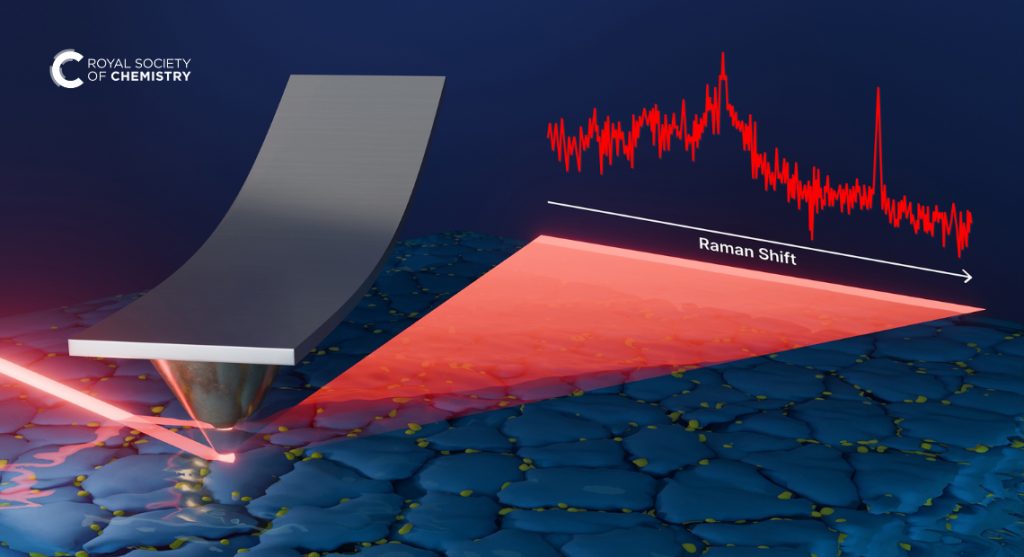
Scientists at IREC have led a landmark study in EES Batteries (RSC) demonstrating, for the first time, that operando Tip-Enhanced Raman Spectroscopy (TERS) can track lithium-ion dynamics at the nanoscale in working battery electrodes (link to RSC Publishing)
The work, entitled “Unraveling nanoscale interfacial kinetics in battery cathodes through operando tip-enhanced Raman spectroscopy”, is authored by Beatrice Laurenti, Juan Carlos Gonzalez-Rosillo, Francesco Chiabrera, Alice Fiocco, Fernanda Monteiro Freitas, Marc Chaigneau, Alex Morata, and ICREA Prof. Albert Tarancón;, led by the Nanoionics and Fuel Cells Department at IREC in collaboration with HORIBA France.
The researchers used LiMn₂O₄ and LiFePO₄ thin films as model cathode systems and showed that operando TERS can distinguish behaviors at the level of individual grains and grain boundaries, with spatial and temporal resolution.
Interfaces—such as grain boundaries and electrode–electrolyte interfaces—play a central role in ion transport, battery efficiency, longevity, and safety. Yet direct observation of buried interfaces under real operating conditions has been extremely challenging. This new implementation of operando TERS bridges that gap by offering chemical and structural resolution at the nanoscale during active battery operation. The technique holds promise for informing the design and optimization of future battery architectures.
The journal has published a cover from this research, an image designed and illustrated by Princess Romero (link to cover).