
Functionalized indium-free transparent electrodes based on hybrid metal-oxide architectures
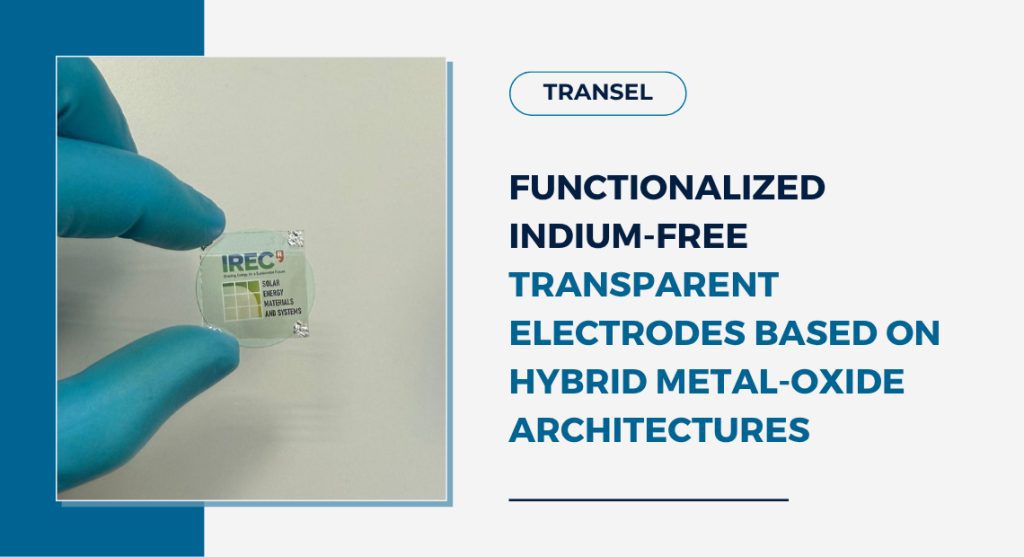
Optoelectronic devices are rapidly becoming an essential part of modern society. They convert light into electricity or vice versa, with applications such as energy generation (photovoltaic cells) and hydrogen production (photoelectrochemical water-splitting systems). A key component in these devices is the transparent electrode (TE), which needs to provide both high transparency and electrical conductivity simultaneously to ensure efficient device operation.
Current TEs rely on transparent conductive oxides based on metal oxides, with the most widely deployed using the critical raw material indium. Moreover, they present limitations in simultaneous transparency and conductivity, chemical and thermal stability and customizability. Therefore, improving TE technology is fundamental for driving the energy transition, enabling clean energy production, and reducing energy demand through improved energy efficiency.
In this context, the TRANSEL project aimed to develop functionalized TEs based on hybrid metal-oxide architectures and to demonstrate their applicability in photovoltaic and photoelectrochemical water-splitting devices. Validating these novel TE technologies in such demanding applications ensures their broader applicability across the optoelectronics field, as these devices impose some of the most stringent performance requirements on TEs.
The Solar Energy Materials and Systems Department at IREC played a leading role in the development of this novel TE architecture by exploring various oxide and metal combinations, with a focus on reducing or fully eliminating the use of critical raw materials, such as the widely used indium. The project also prioritized deposition techniques that are compatible with scalable manufacturing.
As a result, the project successfully demonstrated the replacement of conventional single-layer TEs with oxide/metal/oxide multilayer stacks (AZO/Al/AZO nanolayers, FTO/MOx layers, and FTO/Polyelectrolites) that offer enhanced electrical conductivity while maintaining high optical transparency. In addition, several functionalization strategies were developed, including protective coatings to improve thermal and chemical stability (particularly under high-temperature and chalcogen-rich environments typically used in device fabrication), and charge-selective contact layers based on both inorganic and organic compounds.
The consortium of the TRANSEL project is formed by IREC (coordinator), Universitat Politècnica de Catalunya (UPC) and Universidad Pablo de Olavide (UPO).
Acknowledgements (in Spanish)
TRANSEL (TED2021-129758B-C31) es un proyecto financiado por MCIN/AEI/10.13039/ 501100011033 y por la Unión Europea “NextGenerationEU”/PRTR.
