
HERO project unveils Barcelona’s first hydrogen-powered minibus
A pioneering retrofit initiative driving zero-emission mobility and urban innovation
The HERO – Hydrogen Retrofit project unveiled in Barcelona the first hydrogen-powered urban minibus. This initiative, led by the consortium of TMB, EVARM, EKPO and EIT Urban Mobility, and coordinated by IREC, marks a new step towards a more sustainable and efficient public transport system.
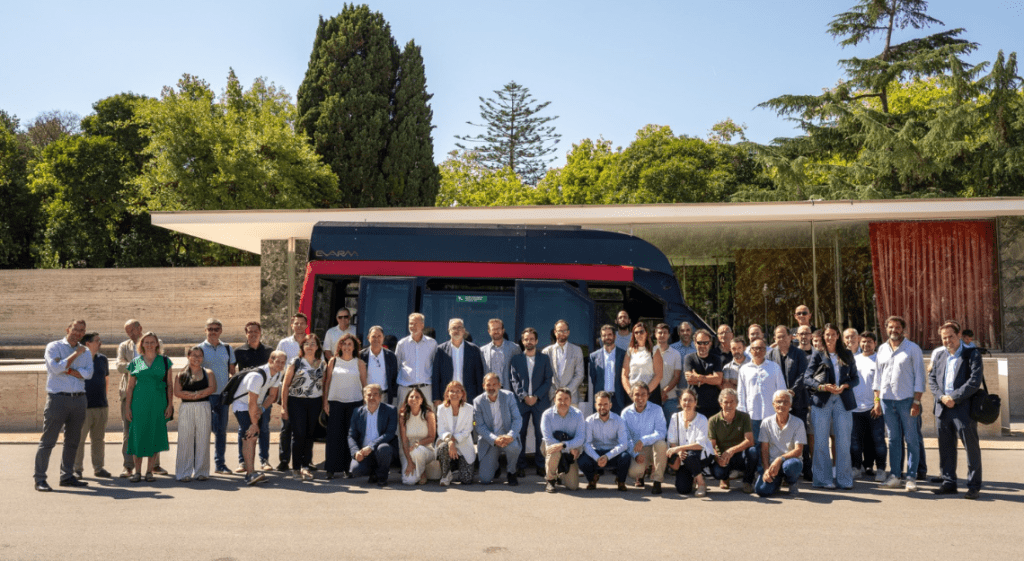
On 19 September, at the Mies van der Rohe Pavilion, the first vehicle retrofitted in Sant Boi de Llobregat by EVARM was officially presented. The HERO project demonstrates the feasibility of replacing a diesel engine with a hydrogen fuel cell propulsion system. The minibus integrates a 35 kWh battery and a fuel cell of up to 120 kW, enabling operation without emissions and with reduced noise levels. It has recently started circulating in real urban environments in Barcelona as a pilot test to gather key data on range, reliability and service integration.
The event featured a welcome address by Xavier Flores, CEO of TMB, who highlighted: “This project is a clear example of the innovation we are driving forward at TMB.”
Xavier Ribas, CEO of EVARM, remarked: “This project has become a reality thanks to institutional support and the collaboration of all stakeholders. It is only the first step of an initiative with international scope.” He also announced that “an international framework agreement for hydrogen storage will soon be formalised.”
Martí Massot, Head of the EIT Urban Mobility Innovation Hub South, added: “This presentation is not a conclusion but the beginning of a public–private collaboration. In just nine months, we have reached a proposal with European projection.” He also stressed that “hydrogen does not compete with electrification but complements it, and will be essential for decarbonising heavy transport.”
Looking ahead, the first commercial units are expected to be launched next year, with refined versions manufactured in Sant Boi de Llobregat.
Tomàs Megía, Head of the Office for the Transformation of the Mobility and Automotive Industries (OPTIMA), described HERO as “an industrial project of great importance for the transformation of the mobility sector.” He underlined “the discreet but crucial role of the administration, through ACCIÓ and the Directorate-General for Industry, in enabling strategic alliances and supporting the creation of the consortium.” He also acknowledged “the coordination role played by IREC, led by Alicia Rodríguez, and the vision of Xavier Ribas as an innovator and pioneer, which have made it possible to progress towards industrial and, in the near future, commercial development.”
Finally, Lluïsa Moret, Mayor of Sant Boi and President of the Barcelona Provincial Council, closed the event by stating: “This project reflects perseverance, talent and courage. Mobility is a right for all citizens, and initiatives such as HERO guarantee equal opportunities through an excellent, sustainable and environmentally respectful public transport network.” She concluded: “Today is an exciting day because we are witnessing a real solution and an effective zero-emission alternative. It is both a source of pride and an institutional commitment to innovation and collective wellbeing.”
The HERO – Hydrogen Retrofit project is part of a broader strategy to promote the use of green hydrogen as a key energy vector for the future of urban mobility. As a leading research centre in the field of energy and hydrogen technologies, IREC has supported the coordination and dissemination of this project, consolidating its commitment to innovation and the transfer of knowledge to the industrial sector.